


Biochar in the circular bionutrient economy
Johannes Lehmann, Edmundo Barrios, Mariana Devault, Lucinda Li, Rebecca Nelson, Johan Six and John Trimmer
PNAS; August 11 2025; 122 (33) e2503668122
Significance
The spatiotemporal disconnect between nutrients derived from excreta and food waste on the one hand and nutrients required for crop production on the other has led to global environmental pollution, disproportionate energy demands, loss of nutrients, and therefore dwindling supplies of finite resources. By strategically managing organic residues, a circular bionutrient economy reduces health and environmental impacts [e.g., greenhouse gas (GHG) emissions and eutrophication] while sustaining crop production. Here, we examine what role biochar can play in transforming nutrients from residues, specifically excreta, that pose an environmental burden into fertilizer products to grow crops.
Abstract
The circular bionutrient economy is defined here as the circular economy of nutrients in managed organic residues. Here, we posit that biochar technology can stimulate the circular bionutrient economy by meeting the following three requirements: 1) nutrients are captured in a dry form, increasing market value and lowering transportation cost; 2) individual nutrients can be captured separately and combined as needed for particular plants and soils; 3) all pathogens and most pollutants can be removed with the notable exception of heavy metals. Pyrolysis and associated moisture removal enabled by the energy released during pyrolysis decreases weight of solid excreta by 85 to 90% and volume by 74 to 90%. This will lower storage and transport costs allowing redistribution of nutrients from production to processing and consumption of food. Incorporating liquid organic residues into nutrient recovery processes is crucial to the circular bionutrient economy. For example, N fertilizer from human feces would only generate about 2% (2.0 to 2.4 Tg N y−1) of current global N application, whereas including urine could increase this fraction to 16 to 17% (15.7 to 16.9 Tg N y−1). Nutrient acquisition by plants can be increased by biochar through nutrient retention and pH buffering in soil. We posit that leveraging biochar to close the nutrient circle requires public–private partnerships in forms of a community of practice and green alliances. These must develop a marketable product that incentivizes private investment. Such products may only be cost competitive with established fertilizer products by internalizing external environmental costs possibly through market mechanisms including but not limited to carbon credits.
See https://www.pnas.org/doi/10.1073/pnas.2503668122
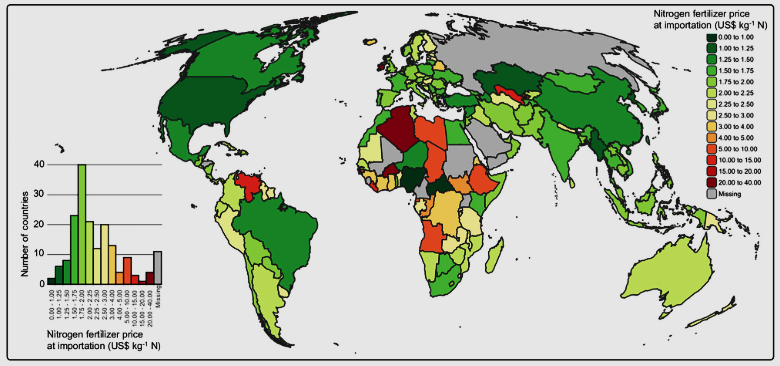
Figure 1: Prices of N in imported mineral fertilizers by country at a global scale. Costs of conventional fertilizers vary greatly at a global scale suggested by price per unit N at importation (averages of all N-bearing fertilizers from https://www.fao.org/faostat/en/) indicating the greatest opportunities for CBE for offsetting fertilizer costs (retail or whole-sale prices for fertilizers are not available by country at a global scale from IFASTAT and FAOSTAT).
Số lần xem: 10
 {mota}
 {mota}
 {mota}
 {mota}
Biochar in the circular bionutrient economy
{mota} {mota}
Progress in Transcriptomics and Metabolomics in Plant Responses to Abiotic Stresses
{mota} {mota}
 {mota}
Fine mapping and prediction of a candidate gene for wrinkled rind in melon (Cucumis melo L.)
{mota}