


Fine mapping and prediction of a candidate gene for wrinkled rind in melon (Cucumis melo L.)
Xufeng Fang, Ziqiao Ji, Min Tao, Xuezheng Wang, Xian Zhang, Zuyun Dai, Zhongzhou Yang, Chaonan Wang, Zicheng Zhu, Shi Liu & Feishi Luan
Theoretical and Applied Genetics; August 18 2025; vol. 138; article 215
Key message
The Cmwr locus was fine mapped to chromosome 2 in wrinkled-rind melon, and MELO3C010304.2 (CmNaa35, encoding an N-α-acetyltransferase) was identified as the most likely candidate gene for wrinkled rind in melon.
Abstract
The wrinkled rind (wr) phenotypic trait in melon is rare, and the regulatory mechanisms and genes governing this feature remain unclear. In this study, genetic analysis of a segregating F2 population derived from the wrinkled rind melon line T16-085 and the smooth rind line T15-022 suggested that the wr trait is controlled by a single recessive gene, designated Cmwr. Scanning electron microscopy suggested that rind wrinkling is caused by the uneven aggregation of rind cells. Bulked segregant analysis (BSA) delimited the candidate region to approximately 1.90 Mb on chromosome 2, genetic linkage analysis refined this locus to a 448.24-kb region, and fine mapping of data from 1140 F2 individuals restricted it to a 72.24-kb region containing eight candidate genes. The analysis of sequence variation in coding regions from the parental lines and eight melon germplasms with distinct rind morphologies indicated that MELO3C010304.2 (annotated as an N-α-acetyltransferase, CmNaa35) was the best candidate gene for the Cmwr locus. Two single nucleotide polymorphism (SNP) loci in the coding region (SNP16,734,095 and SNP16,734,346) co-segregated with the wr trait. The analysis of promoter cis-acting elements and activity indicated that external indole-3-acetic acid treatment induced CmNaa35 expression. Our findings suggest that Cmwr is responsible for the wr trait in melon and provide genetic resources for further investigation, including gene function analysis and the exploration of the molecular mechanisms underlying melon rind wrinkling.
See https://link.springer.com/article/10.1007/s00122-025-05014-7
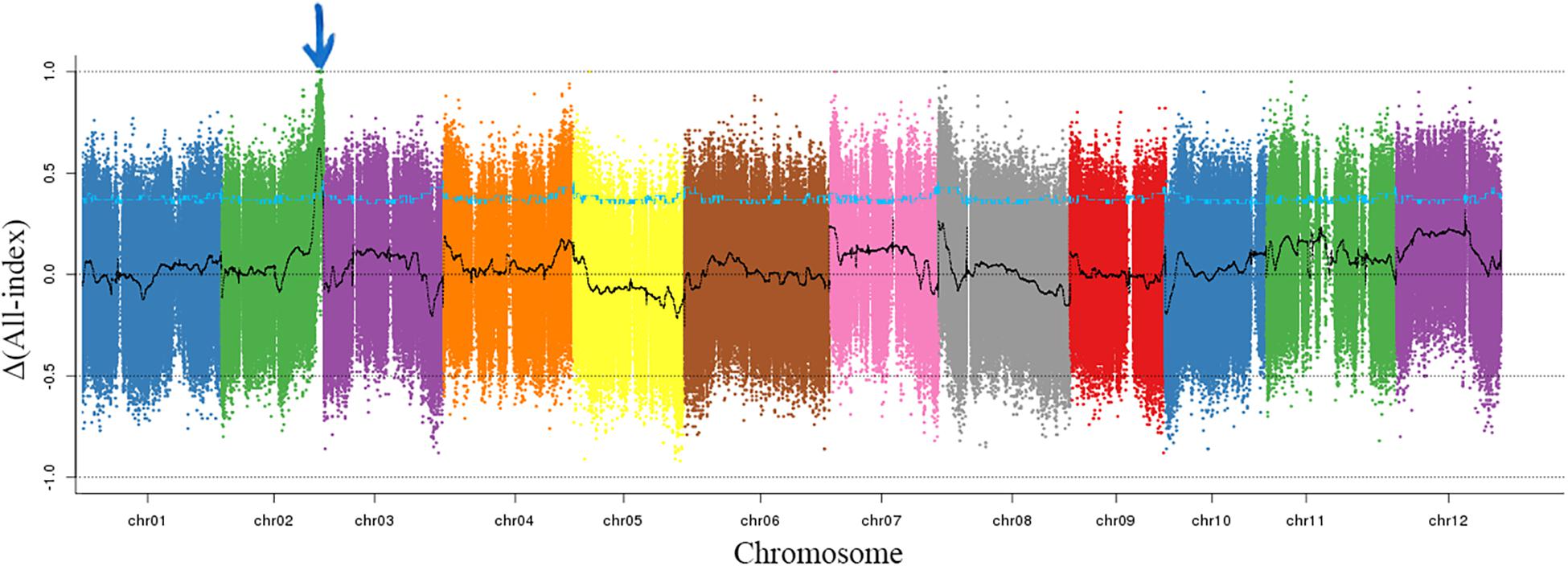
Figure:(All-index) graphs from BSA-seq. The Δ(all-index) was calculated at a 1-Mb intervals with a 50-kb sliding window. One candidate region was identified on chromosome 2 indicating with the blue arrow. (Shen et al. 2021)
Số lần xem: 11
 {mota}
 {mota}
 {mota}
 {mota}
Biochar in the circular bionutrient economy
{mota} {mota}
Progress in Transcriptomics and Metabolomics in Plant Responses to Abiotic Stresses
{mota} {mota}
 {mota}
Fine mapping and prediction of a candidate gene for wrinkled rind in melon (Cucumis melo L.)
{mota}